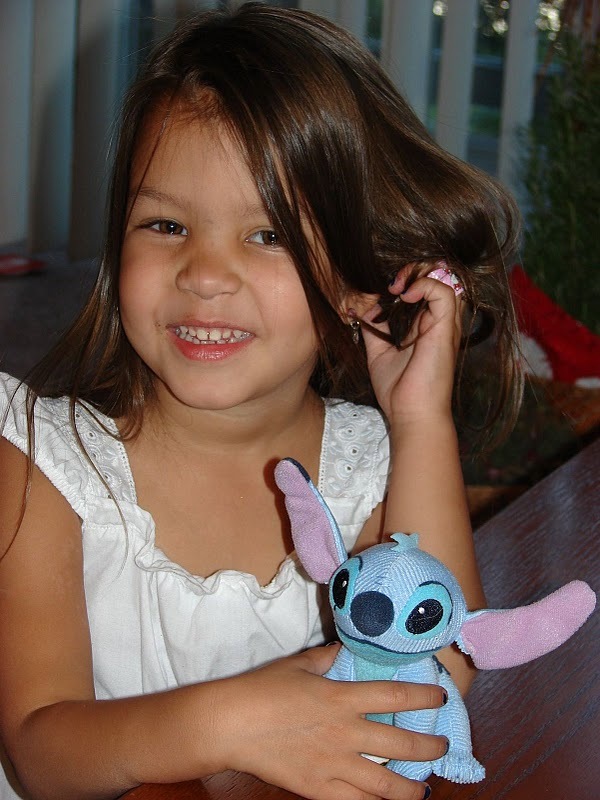
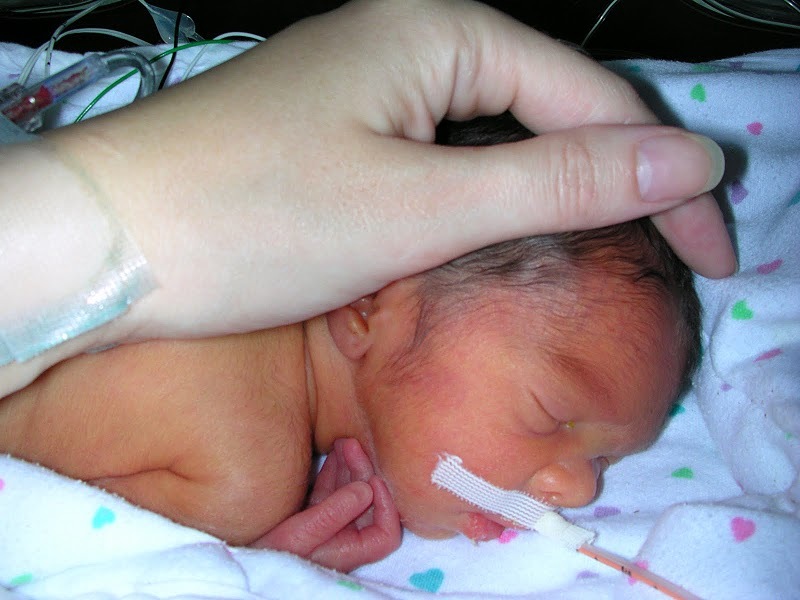
When my youngest daughter was born, I didn’t know if I’d get to keep her. She arrived three months early, weighing in at just over two pounds, and I scrapped her intended middle name in favor of “Grace“–if she stayed with us, it would be entirely a matter of Grace. In her three months in the NICU, every major organ system failed at some time or another, and she regularly stopped breathing in my arms. As a mark of how a person can adjust to anything, I stopped even experiencing an adrenaline rush when she turned grey in my hands; it was just part of a regular day, even after she came home.
When Elena Grace was three months old (weighing a whopping five pounds), I was planning a family party to celebrate the fact that she’d survived to her due-date, and life might be heading toward “normal” with the NICU behind us. The day of our due-date-party, though, I spent an hour of the afternoon sobbing in the parking lot of the audiologist who had just told me she was profoundly deaf. Her ears were perfect, but her auditory nerves weren’t functioning–an irreversible condition, and a diagnosis confirmed by several specialists.

At her baptism, the priest got to a line about “our Lord Jesus, who made the blind to see and the deaf to hear”… and to his consternation, the entire family dissolved into tears.
Miracles like that don’t happen in our world; they fall in that category of “impossible.”
I thought of the long weeks before I’d been allowed to hold her, the hours I’d sat beside her plastic isolette wired with tubes and alarms, reaching my hand through its sterile porthole to touch her head (as close as I could come to holding her) and singing to her, because it was all I could think of to do. I figured if I couldn’t cuddle her, I could at least be present to her through my voice. I sang Amazing Grace over and over and over in those months, hoping she’d know that Mommy was there. Not yet realizing that she couldn’t hear me.
My way to deal with any challenge is to research. Within a month of her diagnosis, I had a bookcase full of marked-up and thoroughly-thumbed books on sign language and education for the deaf. I’d get myself propped up with enthusiasm and assurance—“I can deal with this”—but that confidence was deflated easily, and repeatedly. I was cheered by the sight of a couple in the car next to mine at a stoplight, conversing with one another in Sign. And then the light turned green and they had to stop talking in order to drive. My three-year-old son would chatter at me from the back seat, and I realized I wouldn’t be able to hear her when she started “chattering” from the back seat. I’d given her the loveliest name I knew, and she would never hear it.
At that point I was in the middle of my MFA in creative writing—a topic which suddenly seemed irrelevant to the point of inappropriateness. My own first language, I realized, was one my child could never use—and I didn’t yet know the language I would need to communicate with her. I was frustrated, I was angry, and the Poet-in-me channeled her anger onto the page (…which maybe shows the writing-focus wasn’t as useless as I felt it to be at the time)… During my Master’s defense, when I was supposed to read a selection of my poems, I Signed this one…
Body Language
I am learning a new language
my own
rendered inoperable by my daughter’s deafness
and I am thinking as I fumble silently
of the grace of hula dancers
with stories in their handsthese page-words have lost relevance,
no correlation between printed words
and hers
even the name on her birth certificate no relation
to the name she knows, the motion of fist near chest
strong-mighty-healthy-E, a defiant second christening
that does not lend itself to the page
or to my wishesI imagine discarding the page altogether,
poetry unprinted, I imagine performing
an unwritten thesis,
a single copy existing in the movement of my hands, I imagine
holding my palms to the MLA-nazi in the graduate office
and telling her, “format this!
About six months later, I could have sworn I saw Elena Grace turn her head at a sudden noise. After a week of sneaking up on the poor child with pots and pans, clanging things behind her head to look for reactions, I decided to get “scientific” with a controlled test. I crept up to her crib while she slept, waved my hands all around her face and head (to make sure the movement wasn’t something that would wake her), and then did the same with a noisy rattle in my hand.
She woke.

I sank onto the nursery floor and wept.
More than a dozen specialists—audiologist and neurologists and I-don’t-even-know what other -ologists—are still scratching their heads over the strange case of Elena Grace. With multiple confirmations of a diagnosis for a condition that’s irreversible, the idea that she might hear was (I was told repeatedly) “impossible.”
And as those puzzled specialists repeated the word “impossible” while staring uncomprehendingly at the incontrovertible evidence of her hearing, I began to arrive at a new understanding of that word. Hanging now on her wall is the cross-stitch picture my mother made for me when I was fourteen, with the confirmation verse I had chosen (Luke 1:37): “For nothing shall be impossible with God.”
I am reminded daily that all that’s needed in this life is a little faith, and a little grace. In this case, Elena Grace.


 Kana's Chronicles
Join the Conversation!