
I’m re-reading Robert B. Parker’s ‘Spenser’ novels, stories narrated by a wise-cracking Boston private eye. Parker is long gone, but the series has been continued by writers appointed by his sons, and I continue to enjoy them.
One of the things I’ve always liked about the Spenser novels was how he described people—and specifically, how he described what they were wearing. It’s particularly a matter of amusement in the early novels, because he started writing the Spenser books in the 1970’s, when the clothing was (to me) a matter of amusement in itself. As in, “What were people thinking to dress how they did?” (On the other hand, I see pictures of my mom in the ’70s, and I just think she was cute. Probably my frame of reference is biased.)
I can’t help but note, given my recent (in Hawai’i) reading of the latest Spenser novel, followed by my even more recent reading of the earliest novel, in which he states himself to be almost 40… Well, I can’t help but note that old Spenser should be about 90 years old by now. His knees are giving him trouble now, and he and his erstwhile sidekick Hawk talk about how they’ve been doing what they do for a long time… But he’s still beating up bad guys as if he were in his 40s, or thereabouts. I guess there’s an implied suspension of disbelief.
Kind of like we have with James Bond. Bond changes with the times—and references current culture in every movie, so we know it’s not just a bunch of stories taking place in the ’60s. Same thing with Spenser—his latest book has him definitely referencing 2025 current events and culture, so we’re going to just ignore the fact that he has referenced fifty years‘ worth of “current culture,” and is still young enough to be the kick-ass tough guy that he is. Hawk too.
Part of Spenser’s appeal is that he is a literate detective, considerably smarter than he looks (with his broken nose and fighter’s scar-tissue around the eyes). He regularly specifies that his name is “Spenser with an ‘S,’ like the poet.” (As if anyone but an English major would know the poet who wrote The Faerie Queen in Elizabethan England…)
Another definite point of appeal is his decades-long monogomous love affair with the “girl of his dreams,” a Harvard-educated Jewish shrink. They’ve chosen not to get married, or even to move in together, because what they have works for them. And even in the long-ago episode when Susan (briefly) decided to try something (someone) different, Spenser never wavered. (It made me think a little less of her, but he gets points for faithfulness.)
And finally, Spenser appeals because of his own moral/ethical code, which he seems to have invented from whole cloth, which enables him to remain, steadily, a Good Guy, even when he’s doing Bad Things. There’s machismo in it, sure—but it’s a code based on Honor.
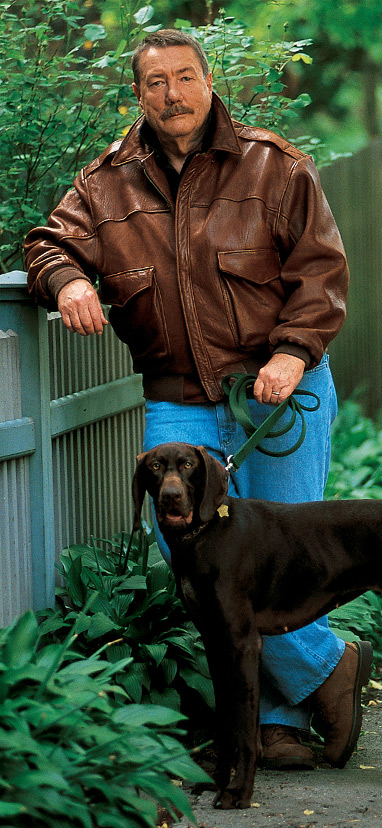
I remember my grandpa watching “Spenser for Hire” when I was a kid, long before I’d read any of the books, but I have trouble connecting that TV show (and its somewhat runty actor) to the books. It doesn’t seem like a fit. What does seem like a fit is the author picture that adorned so many of the paperbacks, of a thuggish looking writer with his dainty looking dog. That’s how I picture Spenser.
 Kana's Chronicles
I haven’t read the Spenser novels, but I watched Spenser for Hire for years. What stayed with me was Spenser’s personal code steady, self-defined, and quietly stubborn, and the way it was tested by the people around him, especially Hawk, whose presence was a constant reminder that doing the right thing doesn’t always mean doing the clean thing.
Dennis
LikeLiked by 1 person
Well put. Sounds like they were pretty true to the books, then. I didn’t really see much when Grandpa was watching—only enough to register, years later when I picked up the books, “Oh, THAT Spenser”… :)
LikeLike
it’s a code based on Honor… 😊
LikeLike
I have read many of the Spenser novels over the years, Robert B Parker is one of my favourite authors
LikeLike
You are not biased. I WAS cute.
LikeLike
Here’s to genetics, Momma!
LikeLike
Avery Brooks was a great choice for Hawk but I can’t see Robert Urich as Spenser.
The tradition of fictional heroes never aging is common enough — the Saint ran from the 1930s on into the early 1970s without aging a day, ditto Perry Mason. Arthur Conan Doyle shifted Holmes into retirement but that’s an exception.
LikeLike
…and Holmes has had many more “lives” in fanfic and homages!
LikeLike
I read a bunch of the novels after I first got into the TV show. The first season was the best, not surprisingly because Parker himself collaborated on it. I read once that he stopped because he was not happy with how they were doing it, but based on the results, I would say he had a positive impact, even if it wasn’t enough for him.
LikeLiked by 1 person
I have to imagine it would be hard, as the CREATOR of a character, to see it get “messed up” by somebody doing it differently from how you’d like…
LikeLike