Keoni and I usually read in bed for a while every evening, and then put on a movie. Netflix is our one “extravagance,” and we tend go on exploratory themes with our movie-ordering—the latest being a comparative look at some of the film-adaptations of Jane Austen’s novels.
Yup, I’ve got a husband who willingly watches “chick flicks” with me. More than that, a husband who has no objection when I hit “play” again on a movie that just finished, for the fun of picking out details and nuances that we missed in the first viewing. Sometimes several times in a row. And a husband who chats with me about screenwriting-choices and character-portrayals and comparative effectiveness of different story-telling techniques…
As a writer, I’ve been fascinated for a while with the storytelling choices of film-makers—specifically, the combined choices of directors and screenwriters in telling a story. And especially in any adaptation from a book, where I can compare the on-screen choices to the on-the-page choices of the original author.
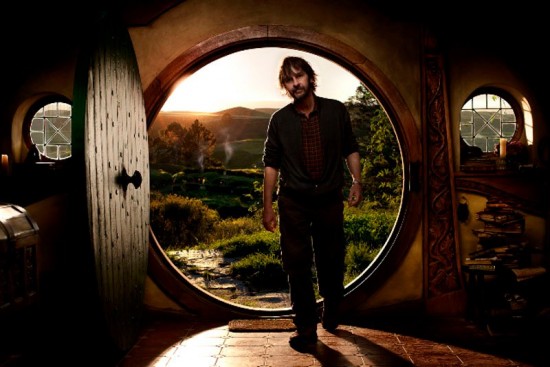
My film-fascination really began with the “extra” footage on the Lord of the Rings films—in addition to a couple dozen hours of how-we-did-it footage, you can watch the entire extended version (12 hours in itself) with voice-over commentary of the director and screen-writers. As I wrote the other day to my blogging-buddy ChatterMaster (who shares a birthday not only with my sister, but with Bilbo and Frodo Baggins), Lord of the Rings is one of the very few films that I actually prefer to the book. Peter Jackson and his crew walked a marvelous line of staying true to the book, while telling the story better. So their combined commentary about the choices they made… Purely fascinating to me. (Yes, I’m a nerd!)
But back to our Austen-exploration… What I enjoy most in reading Austen is how fricking FUNNY she was! (I re-read her novels last week, and Keoni can attest that I giggled my way through all six books.) That was also my favorite “revelation,” as expressed by students, when I was teaching Austen to high-schoolers. Unfortunately (but not without reason, given how they’re often taught), kids tend to equate Classics with dryness, so Austen’s humor (and even her occasional naughty innuendo) came as a shock to most of them.
I think I’ve never been so indignant at a movie-review as the one I recently read (by a professional reviewer, no less) which dissed a version of Emma and asserted that “Austen didn’t write comedies.” I can only think of three possibilities that could account for such an outrageous statement. 1) The reviewer hadn’t read Austen. 2) The reviewer’s sense of humor had been surgically removed. Or 3) She’d had Austen shoved down her throat by one of those English teachers who give the rest of us (not to mention Literature) a bad name. (My own high school English teacher began her class with the pronouncement, “I know you all hate American literature, but I hate it too, and we’re all stuck with it.” I knew I was in for a crap year.)
When it comes to a film adaptation of any Austen novel, one of the main choices of directors-and-screenwriters seems to be whether to play the comical characters to their full comedic potential (which I love), or whether to tone them down to make them a little more realistic and more emotionally accessible (which, strangely enough, I also enjoy). I haven’t yet seen a film that managed to do both.
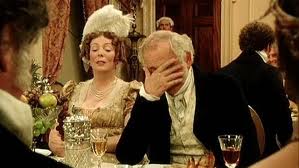
Mr. and Mrs. Bennet, the parents of the heroine Elizabeth in Pride & Prejudice, are a perfect example. As Austen wrote them, and as they’re portrayed in the 1995 BBC/A&E adaptation (or as I prefer to call it, the “Colin Firth version”), they are a hilarious pair. Mrs. Bennett is fluttery, self-absorbed, stupid, and always saying ridiculous things she shouldn’t—overstepping the bounds of propriety and manners at every turn. Mr. Bennett, in his turn, has realized for twenty years that he’d married a pretty face that didn’t have a brain attached to it, and so finds his own peculiar entertainment in ridiculing his wife. His sarcastic comments (which she’s too dim to understand) are even funnier than she is. In contrast, the 2005 film (the “Keira Knightly version”) tones them both down. She’s still a little fluttery and her comments are occasionally embarrassing, but she’s genuinely emotionally involved with her daughters and the family is much closer. Mr. Bennet is far more gentle and affectionate with her—and with his daughters—and the emotional dynamics of the family are very different. Oddly enough, I love both versions.

The “comical” take is far truer to the Austen original, in my opinion, but I’m not such a purist that I can’t enjoy the effects achieved by the different choice in portraying them. I do think that the change alters some of of the motivations in the plot, however, and I’m not sure I’m entirely reconciled to that. In the book, the hero Mr. Darcy struggles against his attraction to Elizabeth Bennett (and warns his friend off her sister) partly because of the difference-in-status between them, but even more because of the socially unacceptable nature of her family’s behavior. It’s completely clear in the book (and in the Colin Firth film) why a marriage there would be socially disastrous for him, and why it becomes a whole story-worth of struggle. That motivation is a little fuzzier in the newer, gentler film, for the simple reason that the Bennetts aren’t so outrageous.
We’ve been playing this same game-of-analysis with Sense and Sensibility (particularly the 1995 version with Emma Thompson & Kate Winslet, and the wonderful 2008 BBC mini-series without any actors I knew, aside from the one I’ll always think of as “Mr. Weasley”)—and we have some Emma on order… That’s the playground where my mind has been spending time lately—pondering the structures of story-telling… I’m curious what YOU think!
 Kana's Chronicles
Join the Conversation!