Last week my mother-in-law stopped over with us, on a grand tour of family-visiting, and dropped a comment about the boredom of her hours on the road. I helped her set up a Libby account so she could borrow audiobooks from her library, and we sent her on her way with a novel in her ear. I renewed my own library card and Libby in the process, so I’ve taken a break from my endlessly-playing “Wheel of Time” books (I bought the whole series a few years ago, and boy have I gotten my money’s worth!) to explore one of my favorite genres of audiobook: memoir read by the author.
Eiren Cafall’s reading of The Mourner’s Bestiary has me riveted. She writes of the impact on her family of Polycystic Kidney Disease, which killed her father, grandfather, great-grandfather, aunt and uncles, basically everyone on her father’s side of her family tree. She has it too, and she doesn’t yet know if she has passed it to her young son. She intertwines the familial experience of disease-induced devastation with childhood memories of Long Island Sound, and she braids those together with descriptions of the ways the world’s marine life is being devastated, decade by decade.
It’s not a cheery book, but it’s one that appeals to me on several levels. It’s beautifully written, it revolves around sea life, and it deals with the impact of disease. My own Crohn’s Disease doesn’t have the same fatal impact of Cafall’s PKD, but it surely shaped my early life (and unfortunately it, too, is genetic, and shaping my son’s life now as well).
I’ve been listening to this book as I treadmill, and today she said something that made me do a thing I never do when I’m exercising: I turned off the book to think. (Generally I find that my own thoughts are the enemy of exercise. Left to itself, my brain will fixate on how much time I have left to go, and tell me I’m too bored to keep going.)
It’s not a new idea, but the way she framed it set my wheels turning. In a study of the impact of PKD on families, there was a positive link between positive affect and positive results.
In other words, in essence, a cheerful attitude makes a significant difference.
My mother recently told me that she admires me for handling years of illness with “cheer and grace”—but I have to say that’s not entirely how I remember it. Especially as it applied to my early years. I remember sullenness. I remember RAGE. I remember a shit-ton of stubbornness, when I refused to drop classes or cancel travel or leave my student-teaching post when my doctor was threatening to hospitalize me.
But okay, cheer was in the mix. I can’t claim “good-person-points” for cheer, though. It was often manufactured, and stemmed from a place of self-centeredness. I have a pathological need to stand out, and in an arena where I couldn’t stand out with grades or awards, I chose “bravery & cheer.” I’d be that patient. There’s not a lot of “credit” to be had in that—except, I suppose, for choosing “cheer” over the other possible ways I could stand out. Still, perhaps even “manufactured” cheer can have some impact on outcomes.
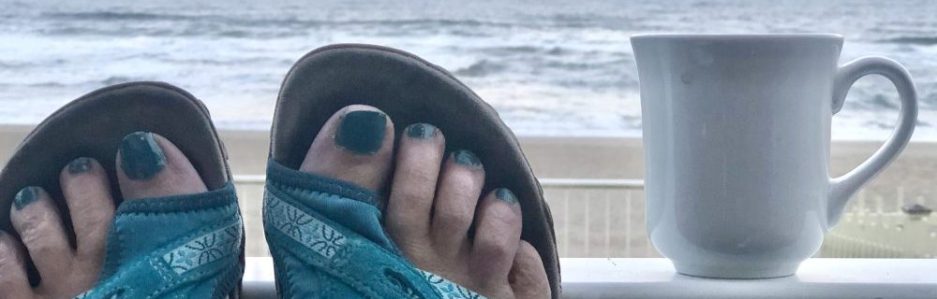
On a related note, my mother and I were discussing, last week, my mental-health downward-slide this summer—or more specifically, why I didn’t identify it sooner. I’ve been pretty good, since my Bipolar diagnosis a decade ago, at being self-aware enough to identify when I’ve lost ground with my mental health… But this time I didn’t see it. I allowed recovery from my foot-surgery to disguise the fact that I was slipping toward the dark. My foot healed, but I still didn’t get up, or get outside, or even relish my usual summer joy of barefootedness. I kept putting on shoes.
Okay, that sounds like a weird item to list, but I’ve often joked (and even written) about barefootedness as a barometer of my mental health. Yet I haven’t once, this summer, grounded myself by stepping into grass without shoes. My foot healed—and within the bandages, dead skin began to peel off. Years’ worth of calluses peeled right off… a shoe-sole worth of calluses… I moulted like a hermit crab getting ready for its next shell… but I stayed locked in with shoes and emotional dimness. How did I not notice that? You can’t “fix” your mental health just by noticing it’s slipping—but you sure as hell can’t fix it if you don’t notice!
One of my earliest-published poems, I wrote in college about my school-time in Hawai’i. It ended with the Hawai’ian word for barefoot: “kama’a’ole, the girl with smiling feet.” I’m meeting with my psychiatrist to see about adjusting my meds, and this morning I walked a bag of garbage to the dumpster without shoes. Nothing glamorous, certainly, but it felt better. It felt more ME. Smiling feet might be just the “positive affect” I need to turn the thing around.

 Kana's Chronicles
…and you will, my so brave Sam. You will. 💕💕
LikeLiked by 1 person
So happy to see your smiling feet again!
I’ve missed your chronicles and am happy that you are posting again.
Sending you lots of love!
-Left brain
LikeLike
Ah, my brain suddenly feels complete!
Sending love back!
-Right brain :)
LikeLike