I’ve been trying, here, to dig down and write some things that are real (even if they don’t frame me in the best light), and what’s on my mind today is vanity. My own vanities are a weird mix—things I literally don’t even bother to look at, and things I obsess about as if they were moral failings. (I’d try to puzzle out the logic behind that dichotomy, but I’m pretty sure logic doesn’t come into it!)
I’ve been mulling over this topic for a few days, ever since my AI image-generating software accidentally disappeared all my images and replaced them with descriptive text.
There’s one cartoon of myself that I had created by “feeding” the thing a few photos of myself—and the descriptive text that popped up for that picture began with, “An attractive middle-aged woman”… My first thought was “how does it KNOW what’s “attractive”?—and my second thought was pleasure (whatever the parameters used to determine it) that it labeled me so.
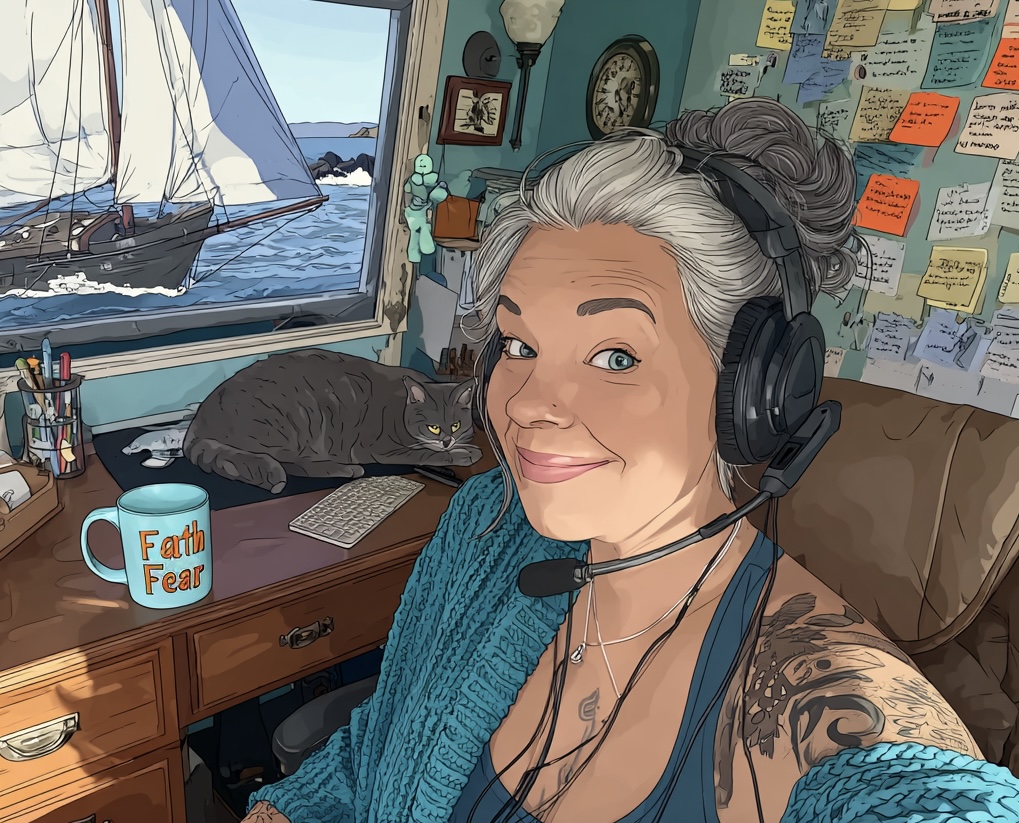
Nope, that’s a lie. My first thought was pleasure at the designation. and then I started wondering about the AI’s inputs & specs & process.
We’re not supposed to admit this about ourselves. We’re supposed to put up that front of false modesty where we pretend not to notice, or pretend not to believe ourselves pretty.
Yet the cosmetics industry gets women to spend billions of dollars every year on trying to make sure we DO look pretty. As for me, I’m a believer that my best “cosmetic” is a good moisturizer. (The tube of lipstick I own is Raisinberry, a color that Mary Kay discontinued more than a decade ago. ‘Nuff said.)
Most mornings I twist my hair up before I’ve turned on the light, and unless I glance up while I’m brushing my teeth, I’m unlikely to catch my own face in the mirror between getting out of bed and getting out of the house.
If someone drew on my face with a Sharpie while I slept, I’d most likely show up at work with the mustache still on!
The two things I like best about my face—a smile with dimples, and my eye color—really aren’t impacted by makeup. (If I want to play up my assets, it’s teal tops that make my eyes “pop.”) What I dislike most about my face—a weak chin!—isn’t impacted by makeup either. So, I guess, what’s the point?
It’s not that I don’t care how my face looks. I can be incredibly vain about a good picture. I just don’t find that fiddling around with makeup appreciably alters how I feel about those pictures, so most days I just can’t be bothered. (Do you notice how we talk about “a good picture,” as if we cared two figs about photographic quality? What we really mean is, “I look good here”—but we’re not supposed to say so.)
On the other end of the spectrum, from my nonchalance about face, is how I feel about that extra belly fat around the middle, and the way fat can bulge around a bra-back. For reasons I can’t fully comprehend, I find it absolutely mortifying when these things show. Mortifying way beyond the mere fact of being unflattering—more like a level of feeling as if I’ve done something BAD. Mortifying even mentioning those things, meaning I’m admitting I have them.
Why is that? Is it only an example of the body-shaming our culture’s media does to all of us, or is there something else behind it?
Recently I packed a tankini swimsuit for a trip—and found, when I got there, that the top was not as loose as I had remembered. In fact, it fit me almost snugly. And I might as well have been naked, I was almost that level of uncomfortable wearing it. It covered everything that’s supposed to be covered (in fact, it’s pretty modest, with a tank-top and a skirt-bottom), and it wasn’t straining at the seams or anything, it just wasn’t loose. Yet I spent most of my pool-time hiding beneath a towel wrapped around myself, because I was so chagrinned by its fit.
SHAME is definitely the right word for the feeling—but I don’t understand WHY. Vanity is certainly in the mix there, but that reaction—turning my towel into a burqa—was stronger than mere vanity discomfited.

Even when I was clinically obese, a condition in which there was no hiding the extra weight and bulk and shape of me, I found myself flushed with shame one day when a dressing-room mirror showed me that the shirt I’d been wearing was not loose enough to hide the bulges around the back of my bra. Again, this was something stronger than just discomfited vanity. A looser shirt would not have disguised the fact of my obesity, but I felt as horrified as I did the time I found I’d been walking around work with the back of my skirt tucked up in my underwear! A shame-level reaction.
I might buck the cultural norms when it comes to cosmetics, but clearly I haven’t escaped all of the cultural conditioning our society imposes…
I’ve been working, again, on losing weight. Five years ago I took off thirty pounds that got me out of the “obese” category and into merely “overweight”—and I’m finally targeting the additional thirty pounds that would get me down to “healthy” weight. (Not the first time I’ve tried to lose more—but the first time I’ve met with any success at it.) Of those 30 pounds, I’m 12 down, and I’m SEEING it, especially in that belly area I’m so hyper-sensitive about.
Twelve pounds doesn’t seem like a lot, I told my mom—a difference that only my husband and I would really be able to see. “Well, think of those five-pounds chubs of hamburger meat at the store,” she answered, “and imagine unpeeling a couple of those packages’-worth from around your middle. That’s not nothing.” Put like that? First of all, ew. But secondly, she’s right.
Amazon brought three new swimsuits yesterday, for our upcoming Hawai’i trip, in a size smaller than any of the ones I own. They fit. They fit in an I-won’t-have-to-hide-beneath-a-towel fashion!
I am wondering, this morning, how our vanities and hang-ups get so deeply hard-wired. This weight loss is such a relief because it’s the only way I can release myself from that obsessive attention to how my clothes fit my middle. I can’t talk myself out of that preoccupation.
It would be more psychologically healthy, I know, if I could (honestly) say I wanted to lose that weight for health reasons. That should be my motivation—but it’s not. Improved health is the bonus, not the main headline.
Fair or not, it’s vanity driving this bus.
Do you have hang-ups that defy rationality in their scope or depth? Do you know where yours come from? Does this happen for men?
 Kana's Chronicles
Join the Conversation!