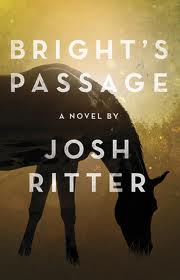
Imagine, for a moment, a musician who’d been named to the list of “100 Greatest Living American Songwriters” before the age of thirty, whose albums are laden with lyrical language and layers of literary and intellectual references… And imagine that same musician writing two hundred pages of fiction with all the lyrical allure of his song-smithing. That’s exactly what we have with Josh Ritter’s first novel, Bright’s Passage.
Henry Bright comes home from World War I with an angel in tow. An argumentative angel, who takes up residence in his horse and meddles in Henry’s life. I’d suggest that the best way to read this book is simply to let the story and the language flow. You could inflict your own analysis on it by worrying about the “whys” of what’s going on–maybe a diagnosis of Post Traumatic Stress Disorder to explain away that absurd angel–but doing so would only distract from the experience of the story itself.
Bright’s life is artfully interwoven in three braided strands throughout the book… His passage from his isolated mountain home after burying his young wife, journeying with a newborn son (and a goat, and the persnickety horse-angel), trudging toward a town and “feeding the child with his trigger finger dipped in the goat’s milk”… His experiences in the trenches of France, where the angel first attached itself to him… And his memories of childhood in a mountain mining community–memories of his mother, who raised him alone after the mines crushed his father, and of the girl Rachel who would (briefly) become his wife when he returned from the war.
A reader determined to dissect might decide Bright is a damaged and delusional man who imagined that bossy angel into his horse. I’m actually inclined to think Bright himself is perfectly sound–although his angel could certainly benefit from some time on the therapy couch. Whatever conclusions you draw as you read, they’ll be yours to keep; Josh doesn’t contaminate his story-telling (or insult his readers) with explanations.
I just looked up Josh’s own comments about the book on Amazon, and was disgruntled to find the exact phrase I’d just written, about the angel who “takes up residence in Henry’s horse.” Dangit, now I’ll have to edit so people don’t think I was cribbing. Or… I’ll leave it as is, and have a laugh. We did have the same English teachers, after all… Josh was a few years behind me in school, and one of my memories (brought to mind by Henry Bright’s recollection of a childhood Christmas program in which he played the donkey and Rachel the angel) is of junior-high Josh dressed as Joseph, across our church’s prop-manger from my little sister in a blue veil.

Our hometown of Moscow Idaho is the kind of small town where folks showed up spontaneously when the locally owned BookPeople moved to a new location across the street; Main Street shut down for the length of a summer evening while a bucket-brigade of volunteers passed books across the street from hand to hand until the move was compete. Which is probably why my favorite publicity shot of Josh is this one of him singing in front of our own BookPeople store.
I can honestly claim, though, that the hometown connection played no part in my first fascination with Josh’s music. I was fooling around on iTunes a few years ago, whimsically searching for songs with “Idaho” in the title–and fell in love with his, making no connection at the time between the name on the album and the kid from my sister’s class. I downloaded the song–and everything else of his that I could find–and the very next morning when I started up my car it kicked the radio to life in the middle of this same song, which Josh was performing live on NPR’s “Talk of the Nation.” Crazy synchronicity, I was thinking, when my cell phone rang and my mom asked if I remembered Josh Ritter from our church… Oh. That Josh Ritter. (I’d just thought the name was familiar because… well, because CDs are made by famous people. Bright one, I am.)
If you’re not familiar with his music, check out “Kathleen” or “Good Man.” I’ve posted “Idaho” below because… well, because it’s Idaho.
A person who wants light fluffy lyrics would probably find Josh’s philosophical lines frustrating–and the same might go for his novel. For the reader or listener who doesn’t object to thinking, however, Josh’s writing–whether song-lyrics or novel–is an absolute treasure of the mind. This a book I would happily read just for the language–he’s truly a word-wizard.
I just hope our English teachers are proud.
Intrigued? Check out the book at Amazon!
Video of Josh singing “Idaho”…


Join the Conversation!