
The summer I graduated from university, I joined my mom’s Karate class for a couple months. She had been participating for a year or so in a class comprised entirely of women (aside from the male Sensei), and pleasantly free of any of the pressures of machismo or testosterone.
I thoroughly enjoyed the lessons, and the time with my Mom—both in class, and practicing the precisely choreographed katas in her back yard. The katas themselves are series of specific movements, designed to train your muscles to react rapidly without waiting on input from the brain. There’s something peaceful and satisfying—almost meditative—in the practice, even though the ultimate application of those moves may not be entirely intended as a peaceful pursuit…

I was only enrolled for the couple months between my college graduation and my planned wedding, and my lasting memory of my Testing (when I expected to add a stripe to my white belt, but walked away instead with a whole new belt-color) is my mother’s repeated yelps from the side: “Don’t hit her arms! It’s a sleeveless wedding dress!” Given how easily I bruise, it’s nothing short of miraculous that I walked down the aisle the following week without any visible bruises. My mom, on the other hand, broke a bone in her foot during her own Testing (for a fifth belt-color, if I remember right) and was told she couldn’t wear that perfect pair of shoes she had found for the wedding. She wore them anyway; there’s a little bit of stubbornness in our family!

Sometimes during that summer, the two of us would attend extra practices at another university Dojo—a mixed-gender class with the advantage of additional assistance from some good-looking male Black Belts. (Yeah, I know—I just said I was about to get married… But I think it was my mom who quipped about marriage: “You can still window-shop; you just can’t finger the goods!“)
On one of those occasions, a Black Belt was working through a set of defensive moves with me, and tortuously trying to explain why they work. His abstruse explication suddenly solidified in my head (fresh out of several semesters of Physics) with the single word he’d been attempting to illustrate.

“It’s Torque, isn’t it?” I blurted. I sometimes think men believe the word “Torque” belongs to them. If I were marketing a testosterone-booster for a pharmaceutical company, that’s what I would name it!
Gendered musings aside, Physics are the underlying explanation for every martial art. The simple forces studied in Physics 101 explain every move in martial arts.
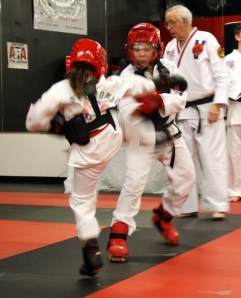
Leverage, torque, momentum, center of gravity… A smaller or less muscled person can overcome a much larger and more powerful adversary by applying simple Physics—as Elena Grace proved in her Black Belt testing for Taekwondo last weekend.
Christian and Elena Grace have been enrolled for several years now in a school that was relatively new when they started. Earlier this year, Christian became the first in this school to earn his Black Belt after starting in the “Junior ” class, and this weekend Elena Grace became the first in the school to earn her Black Belt after starting in the “Tiny Tiger” class of five-year-olds.
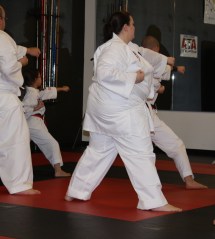
Her diminutive figure looked humorously out of place among the mostly-adult group Friday night, but the moves she’s learning could work effectively on the fierce-looking military type to her right, or the overweight balding guy behind her. She doesn’t need size, because she has the “magic” of Physics behind her.
I know that magic and science are thought to be opposites; after all, “magic” is a word usually used for things that science can’t seem to explain. But science has always seemed pretty magical to me. Particularly Physics, where things happen that seem completely counter-intuitive to our “common sense.”
I’ve been having similar thoughts this week about Family. Talk about inexplicable forces of attraction and repulsion…
Last weekend our sons were in Kapena’s room having a “Brothers Talk,” and I overheard some snippets that made me smile. Kapena was orating earnestly: “There’s nothing more important than Family.” (Indeed, his second tattoo was the word ‘Ohana—Hawai’ian for ‘Family’.) “But what I’ve figured out is that Family isn’t just about blood.”
If anyone can speak on this topic, it’s Kapena. He has five half-siblings (three through his dad and two through his mom), one full brother, and two step-siblings—so he has experienced the full range. His mom refuses to acknowledge that his dad’s kids are his siblings; I once heard her ask him derisively, “why would you even call them your siblings?” (Of course, her kids are unquestionably his brother & sister…) I was proud of his answer on that occasion: “It’s not a matter of opinion, Mom; it’s biology.”
It’s clear, with him, that the degree of blood relationship has very little to do with the strength of the family bond. He has grown very close with one of his older sisters (Keoni’s daughter Anela), with whom he got a matching “Tyler” tattoo on his sixteenth birthday. His full brother alternates between abusing him and asking for money, and Kapena doesn’t speak with him any more. And then there’s his step-brother (though Kapena never uses the “step” designation in referring to him), about whom Kapena feels very brotherly. Hence the chat the other day.
At the end of the day, families may be formed by biology—but relationships are formed by choice. Science with a little magic thrown in! I’ll leave you with Erma Bombeck’s description of Family, which has always made me smile:
The family. We were a strange little band of characters trudging through life sharing diseases and toothpaste, coveting one another’s desserts, hiding shampoo, borrowing money, locking each other out of our rooms, inflicting pain and kissing to heal it in the same instant, loving, laughing, defending, and trying to figure out the common thread that bound us all together.


Join the Conversation!