
I have a bone to pick with Professor Williams. In an entire college semester of a class devoted exclusively to Shakespeare’s work, he never once mentioned that there was any question about who had actually written those works.
That feels to me like a massive omission.
The omission itself tells me Professor Williams’s stance in the argument (and it IS an argument!—a fierce one, a rancorous one, a book-throwing fit kind of fight). The English-Lit Establishment (and there IS one—a fierce one, a rancorous one, an insult-hurling kind of Establishment) insists on authorship by “the man from Stratford,” earning its members the designation of “Stratfordians.” The detractors come in a number of flavors (Baconians, Oxfordians, and so on), but I’m actually less interested in a positive I.D. of the author than I am in the underlying actuality of Shakespeare’s works NOT having been written by, well, Shakespeare.
I would have taken it for a crackpot conspiracy theory (as the Stratfordians do, in fact, characterize it), except… There’s actually quite a lot of evidence that, all considered, makes it improbable that William Shakspere wrote the works. That “improbable” bears strong emphasis—I’d actually go almost all the way to “impossible.”
Okay, first let me say that I’m kind of amazed by the breadth of Elizabethan documentation still available for researchers to peruse. I’d have figured it would be thin on the ground, but there’s documentation of all kinds of things!—just not documentation of the things you’d expect to find, if William Shakspere (one of the several ways he spelled his name in the six extant signatures we have) had written the works with Shakespeare’s name on them.
The evidence piles up, and fills entire books (literally), but the bit that does it for me is the fact that all signs point to the Stratford man being illiterate. In many of his business dealings, he “signed” with a seal (in his later years he was affluent enough to have a seal made, rather than signing with a “mark”), and the six aforementioned signatures are scraggly, to say the least. They’re scraggly, like a person trying to copy what someone else spelled out for him, and they’re spelled differently, and even on the three pages of his will (presumably signed at the same time) the different signatures are so different as to look like three different people attempted them. (I would say “wrote” them, but “attempted” is more fitting.) See for yourself. Is it difficult to imagine that hand penning the world’s most revered literature?

Add to that the fact that his will disposed of property with great specificity (his “second best bed” to his wife, etc.), but made zero mention of a single book, let alone manuscripts or archives of writing. His parents were illiterate, his daughters were illiterate (wouldn’t a great man of letters ensure his offspring could at least read?), and if he went to school at all (there are records from the local school, but no record that he was in it) he was definitely out of school by age 12, when his father needed his help at work. Maybe a self-taught person could learn all the classical works to which the writer alludes, not to mention the Latin, the colloquial Italian, the full conversations’-worth of French used in the plays…
But self-teaching would require, well, books.
There really is quite a lot more evidence, but illiteracy is the one that does it for me.
The attribution of the works was not accidental. In other words, there IS a conspiracy of sorts at play here. Someone needed an allonym—which is like a pseudonym, except the name taken on is one that belongs to a real person. Someone needed a “front” to publish their work, and used this man’s name, on purpose. It could have been a woman (because women weren’t allowed to be “men of letters”). It could have been a nobleman (whose reputation and political aspirations would be ruined by writing for theatre). There’s actually a very strong case for a man I had never heard of: Edward de Vere, the 17th Earl of Oxford.
Well, the sonnets say it straight out: that the writing would be immortal, but his (her?) name would die with his (her?) body.
Does it “matter”? Does it make a difference to know who did (or more accurately, who didn’t) write the works? Well, yes and no.
“No” because the works can stand alone as the example of human genius that they are.
But there’s the opportunity to read through the lens of biographical influences, and that can lend new shades of meaning to the reading. As a writer, I always want to know about the process, the creation, the transformation of a person’s life and experience into a person’s creative output. So “Yes,” because I’m always looking for the “how” of a writer. In my practice of “biographical literary criticism,” it does matter whether I’m looking at the Stratford glover’s son (Shakspere), the earl (Oxford), the attorney (Bacon), the spy (Marlowe), the Lord Chancellor’s courtesan (Bassano)…
There would be some very different “hows” among those candidates! Not knowing the true identity, I won’t know the real “how.” But at least I know not to try to wrangle a “how” out of the Stratford guy.
What does interest me, in all this, is the ferocity with which the “Stratfordians” cling to their guy, in the face of all rationality and evidence. Famous Shakespearean scholars rage at those who question the authorship, attacking them as if they committed a sin against humanity by even asking the question. As if “asking questions” were not the very basis and essence of scholarship.
Then they behave as if the question didn’t exist. (Professor Williams, I’m looking at you.)
The question itself is not new. Possibly the best-crafted argument was published in 1920, by a scholar with the unfortunate name of J. Thomas Looney. (You can guess what the Stratfordians did with that!) He lays out a very strong case for the Earl of Oxford—but even if you don’t go for his candidate, what stands out is the very strong case he lays out against the possibility of William Shakspere writing what he is supposed to have written. This case would hold up in a court of law. (Another area, by the way, where the writer showed substantial and specific expertise.)
Frankly, it’s embarrassing to go a quarter-century with an English diploma, without knowing any of this. And that’s the bone I have to pick with Professor Williams.
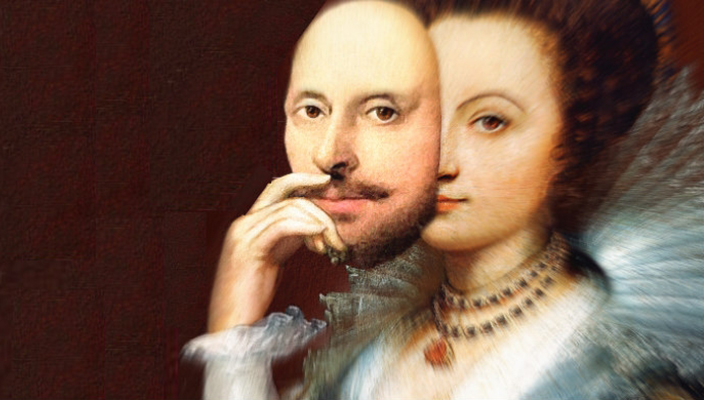
(art from the cover of Steve Weitzenkorn’s book, Shakespeare’s Conspirator)
 Kana's Chronicles
My Shakespeare professor at West Liberty College in West Virginia did explore the various other “suspects” when I took the class back in 1973. He favored Marlowe, but would not rule out Will as the author of a percentage of the plays. The funniest thing I remember was him declaring the bard as “the humble son of William Stratford and Mary Avon” with an ornery wink. Loved those English major days!
LikeLike
Marlowe IS an intriguing candidate! The coroner’s inquest following his death(?) sure has a whiff of “cover-up” about it… ;)
LikeLike
Yes!!!
LikeLike
Ooh, and the perfect title, too!
LikeLike