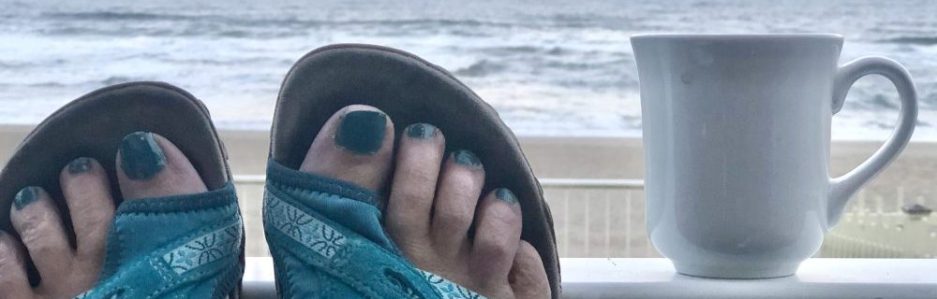
In the course of writing my whale-sized whaling novel, I’ve accumulated a long shelf’s worth of books on whaling, and whales, and wooden sailing ships, and navigation—because for a nerd-brain like mine, at least half the fun is in the research and the details.

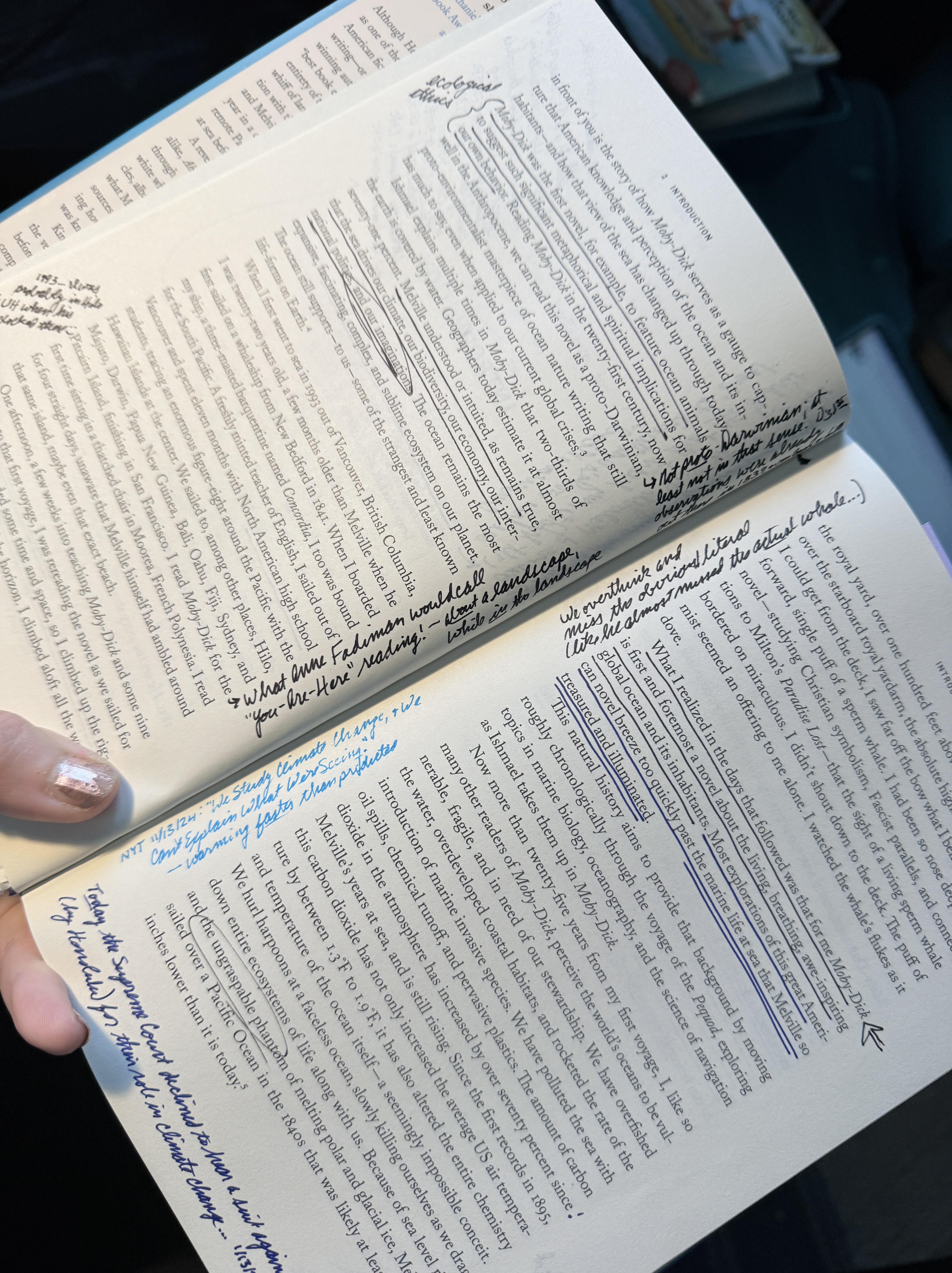
For a nerd-brain like mine, having gone to great lengths for the details, it’s disconcerting to stumble across what appears to be a detail I got wrong. And that’s what happened to me, while I was in the middle of soaking up Richard J. King’s Ahab’s Rolling Sea. King teaches “Maritime Literature” (wow, that’s a JOB?), and this book delves into a myriad of details of biology and oceanography and natural history as they relate to the ultimate, classic whaling novel, Moby-Dick. My copy is very thoroughly underlined and annotated, interlaced with quotes from Melville and lines of poetry by Walt Whitman.
But there was this one detail that threw me for a loop. It was a matter of the lookouts on whaleships, which took the form of simple cross-trees for many decades, with the later addition (on some ships) of iron hoops. Shaped like a pair of spectacles laid face-down, the hoops could encircle sailors at about waist-height, to give them a little more security at their mast-head lookouts. My novel is set in 1841—the same year Melville embarked on his own whaling cruise—and I’d outfitted my fictional ship with lookout hoops. And here was my stumbling block: King wrote that the hoops didn’t come into use until several decades after Melville’s whaling days.
Laugh at me if you will (go ahead—I’ll wait while you do), but I like to have my details correct. Hence the “research library.” (And did I mention? My nerd-brain finds this fun.) Sure, I could just write the hoops out of the book—but now I was intrigued! So I combed through all my references, and memoirs by whalemen, and drawings by sailors, trying to get a fix on when those hoops came into use. Trying to get a fix I why I HAD been sure enough of their usage to build them unquestioningly into my ship. And coming up empty, I resolved to go to the source, to inquire about his source. I wrote to Rich King, explained what I was in the middle of, and asked if he could tell me anything more.
King’s response was everything that’s gracious and generous—he rifled through his own books and images of whaleships, looking for any drawings or descriptions that could help us nail down a definitive timeline. Ultimately we found an “earliest mention,” which we could date to 1850, and I retired the question, satisfied that it was “close enough” for me to leave my hoops in place.

Having enjoyed his Sailing Alone, as well as his Ahab book and email correspondence, I tackled King’s Meeting Tom Brady this week, despite its subject matter being rather outside my usual range of reading topics. Subtitled “One Man’s Quest for Truth, Enlightenment, and a Simple Game of Catch with the Patriots Quarterback,” this book is exactly that—the record of a quest (with his own humorous pen-and-watercolor sketches to illustrate the endeavor).
King chronicles his quest through the 2014 football season—his evolving relationship with the Pats football franchise as he watches preseason practices and regular-season games, trying all the way through the playoffs to get a sit-down (or rather, a stand-up) with Brady. It just so happens that I watched my first football game in almost twenty years, last Sunday, with my mom, who’s an avid Seahawks fan. She and I were in Tacoma at the sailboat, packing it up and cleaning it out, and we took a few hours’ break to walk down the waterfront to Rock the Dock, a sports bar with a great fried-oyster plate. We made our dinners last for a very long time, and nursed our soda & iced tea, and tipped the waitress extravagantly for taking up her table. The ‘hawks lost, literally in the final two seconds—and although I haven’t missed watching football, I enjoyed the game.
King writes of his return to football-watching as fulfilling a need for something masculine in his life, with the onset of middle age combined with his early fatherhood-years with a young daughter. Oddly enough, it’s something I understand, though my timing and context were different. Football-watching fulfilled a function for me, in younger years, of connecting with some masculinity around me. I began watching with my dad in junior high—he explained the rules and nuances and strategies, and watching the Sunday games became our “bonding thing.”
I also very quickly discovered that an honest interest in football gave me the perfect entrée with junior high boys. While other girls were giggling and batting eyes from across the cafeteria, I was deep in the Monday-morning huddle of boys, regaling each other and rehashing the weekend’s games and plays.
I imagine I have that background to thank for being able to fully enjoy King’s book, which retails the games of that 2014 season, interspersed with his efforts to get face-to-face with Brady. He writes with humor and charm, and I found myself thinking, about two-thirds of the way through, that it would be awesome if he never did get that meeting. Not awesome for Rich, obviously, since he really wanted it—but an awesome shape for the book to take, if the journey WERE the journey, even without that much-wished-for culmination.
Given the title—spoiler alert!—I was pleasantly surprised when that did turn out to be the case. The “moral” of this story isn’t a try-till-you-succeed trope. It’s a book about an endeavor that didn’t turn out how the writer hoped. It resonates with me, right now, that the JOURNEY is still worth the writing-about. The true moral, if there can be said to be one, comes in the form of words-of-wisdom from his five-year-old, Alice.
Dad tells her a story about a peddler trying to meet the king, but he can’t get past the palace security, no matter how many times he knocks at the castle gate. “Daddy,” [she says] “do you know how many peddlers have been knocking at the king’s door?” Dad defends the peddler’s mission, saying, “Maybe the king can give him some wisdom. Maybe the king can help the peddler understand how to feel more satisfied, maybe—“
“Daddy,” [Alice interrupts] “the peddler has to do this by himself, okay? I want a monster story tomorrow.”
 Kana's Chronicles
Very interesting! Good for you for giving your “nerd brain” the research it craves!
LikeLike
It’s a voracious beastie, no doubt about it! ;)
LikeLiked by 1 person
Sometimes researching is more gratifying than the writing!
LikeLike
That’s SO true! I’ve spent whole days going down delicious rabbit holes without even getting around to the writing part… And very often, the detail I end up using wasn’t the thing I began my search looking for—it’s something I stumbled across in the researching, something I wasn’t even looking for. Too much fun!
LikeLiked by 1 person