
I’ve always been drawn to the aesthetic of collage, and my office door in our house is a perfect example. Actually, two examples—the door to the room that used to be my office (now our guest room) is entirely collaged with stickers about books and reading and travel and ocean and prayer, with some photos and cards and washi tape for good measure. Truthfully, there’s not a lot of door visible. Just how I like it.

That room’s window opens onto our front porch, so there’s actually not a lot of natural light that comes in, so a few years ago we swapped the office and guest room so I could have some lovely afternoon-light through my office window. On this office door my collage consists of six writers’ pictures. I used my Cricut to make a gold sticker of each writer’s signature, their own handwriting across their pictures.
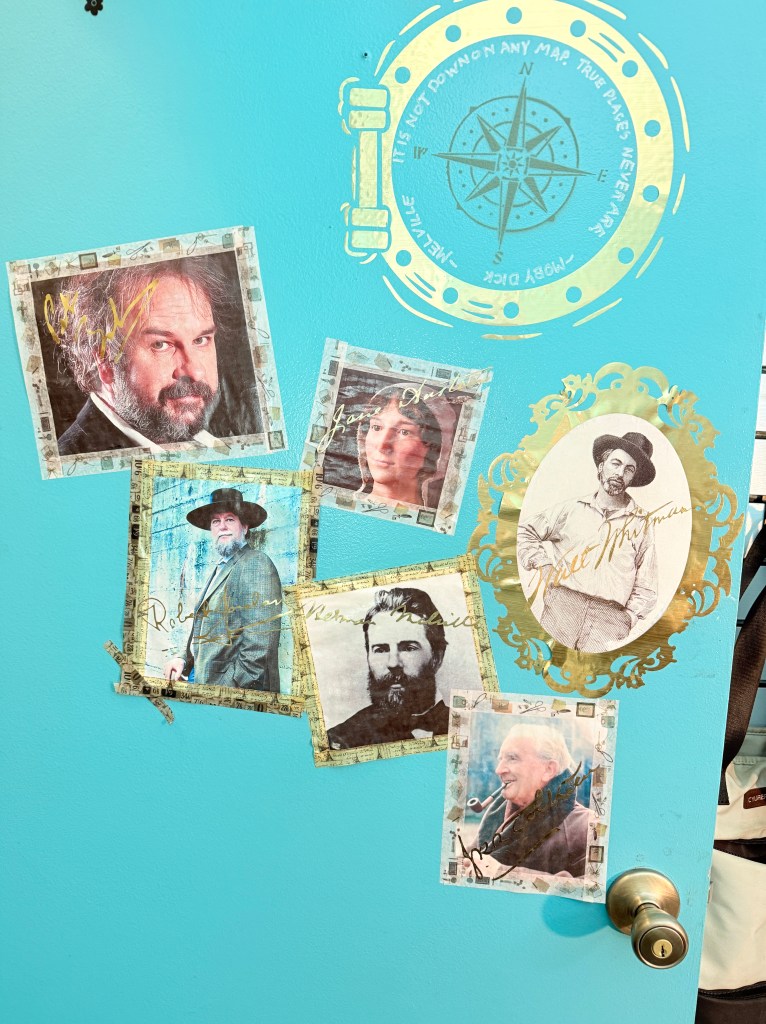
It’s my wall of heroes.
Walt Whitman.
Herman Melville.
Jane Austen.
Robert Jordan.
J.R.R. Tolkien
Peter Jackson.
Perhaps I should have said “writers and storytellers.” Peter Jackson is a film-maker, but he makes the list for what he did with J.R.R. Tolkien’s epic fantasy, The Lord of the Rings. (Also The Hobbit—but he had already made my heroes wall before he undertook that second project.) Tolkien created an amazing world (he “made the door” for it), but his storytelling is cumbersome and awkward. Jackson took what Tolkien created and told the story better. He walked an amazing line of staying true to Tolkien’s creations and intentions, while putting it together in slightly different ways. I’ve obsessively watched all the “making of” footage, and the writers’ and director’s commentary over all ten hours of the film, talking about their storytelling choices throughout the making. Jackson held every detail of that massive project in his internal vision board, and brought it off so well that his picture is on the door even though he didn’t create the world.
Tolkien has my utmost respect, as a linguist and a creator—and Jackson’s interpretation of Tolkien’s creation marks him as an exquisitely expert storyteller.
Jane Austen would have made the door for Pride & Prejudice alone, and Emma and Sense & Sensibility come in a close second and third. She had such a sense of humor, so much insight into people, such a way with turn of phrase—and all that in an environment where women were barely accepted as writers. Pride & Prejudice has spawned more fanfic and knock-offs and reboots and homages than probably any other work of fiction besides, perhaps, Sherlock Holmes. She managed to produce the ultimate romantic hero, the most appealing humorous heroine, and hate-to-love trajectory that remains a classic trope. She nailed it with that one book.
Walt Whitman, as I wrote earlier this month in “Poetry Ambush,” single-handedly converted me from a hater-of-poetry to a student majoring in Creative Writing, Poetry.
Herman Melville wrote the book that seems to contain the world and everything in it, with all of his detours and observations wrapped around the single, anguished quest for a white whale. It’s so iconic that millions of people who have never read the book understand what is meant by “a white whale.” It’s a book you can read dozens of times and never get to the bottom of it, because there’s so much in it. Melville died before his book was recognized as the work of art it is, and I’ve always wished I could go back in time to whisper in his ear that his magnum opus would actually be considered a Great Novel, despite its early commercial failure. It’s such a shame that he died without knowing it. My own whaling novel is inextricably entangled with Moby-Dick, its creation inextricably tangled with my reading of Moby-Dick.
Robert Jordan made the door for his creation of a world and languages even more detailed and lavish than Tolkien’s, and with the added skill of being the better storyteller. His Wheel of Time series, though it consists of fourteen hefty books, I have re-read and re-read and re-read. I have the series on continual loop in audiobook format—it’s what I listen to when I’m washing dishes and pulling weeds and driving to the bank. I know scenes practically by heart, and I still love to hear them, that’s how good he is. He makes the door.
That’s my wall of heroes, writers I admire and (most critically) from whom I hope I learn.

 Kana's Chronicles
I love that! Your aesthetic resonates with me.
LikeLike
That’s comforting—sometimes I wonder if I’m behaving like a teenager with stickers on my door… (And then I decide I don’t care.) :)
LikeLiked by 2 people
Some sticker doors are not my thing but that is just a difference in vision. The way you do it is very tasteful and does not come off as childish but respectful to me. Again, not that is really matters since it is your door lol
LikeLike
That’s true—but nice to hear, all the same ;)
LikeLiked by 1 person
I don’t know all of your heroes’ work. You have sparked my interest on the others. Thanks.
LikeLiked by 2 people
Excuse me while I go to re-read Pride and Prejudice.
LikeLiked by 2 people
Always worth a re-read! :)
LikeLiked by 1 person
I should have added, “NOT in Spanish!”
LikeLike
What a fantastic homage towards the writers.
LikeLiked by 2 people
my homage collage… ;)
LikeLike
I love doing collage too. ❣️❣️
LikeLiked by 1 person
I don’t know why, but there’s something so deeply satisfying about it! Maybe its inherent “messiness” appeals?
LikeLiked by 1 person
It’s very freeing. When I ran group workshops exploring creativity and self expression I often started with collage because it’s so liberating. One one has so many options when it comes to images, text and details.
LikeLike
That’s very true!
LikeLiked by 1 person
Such a refreshing post, Kana. Absolutely loved it. And yep, Jane Austen an absolutely marvellous writer. ☺️
LikeLiked by 1 person
Isn’t she just? :)
LikeLiked by 1 person
Kelvin, thanks for sharing this rich post on your blog. I enjoyed meeting Kana.
xxxx
LikeLiked by 2 people
So glad. She has a nice way with words and a pleasing style.
LikeLiked by 2 people
🙂
LikeLiked by 1 person
A pleasure! :)
LikeLiked by 1 person
🙂
LikeLike
I like the sound of this, I like a collage
LikeLiked by 2 people
It’s remarkable; I love it!
LikeLiked by 2 people
Love this idea, Kana and there are some phenomenal people up there!
LikeLiked by 2 people
what a great collection of co-workers!
LikeLike
Great set of heroic choices; and agree completely about Peter Jackson’s successful bringing to life of the world of LOTR.
LikeLiked by 1 person
Hi Kana, such a fun post here, and as noted, Kelvin shared your post in his vlog and I am so glad he did. I agree with you on this sentiment, wishing, ” I could go back in time to whisper in his ear that his magnum opus would actually be considered a Great Novel, despite its early commercial failure.” And I guess it is a reminder to stay true to our projects because we just never know what will unfold… and when.
:) ~Yvette
LikeLiked by 1 person
SO true! :)
LikeLiked by 1 person
🙂
LikeLike