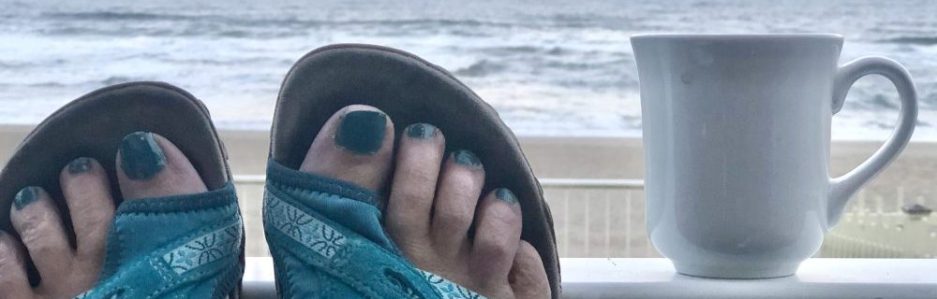
I had a pleasant email this morning from a fellow blogger, JJ Pickletoes, and one of his questions deserved some thought.
And as I thought, I remembered a principle I followed as a teacher: if one person asked the question, other people probably had that same question too. In a classroom, I’d address it openly for the whole class to benefit from the answer—and on the same principle, I figured I might address Mr. Pickletoes’s question to a broader audience here.

Here’s the question: “What advice would you share about your blog to others that are interested?” (I appreciate that qualifier at the end. Let’s assume we have an audience of interested parties!)
I certainly won’t position myself as an “expert.” There are people who have more followers, people who make money from their blogs, people who blog as a profession, people who have blogged for longer… But I can speak from the position of fourteen years of being a blogger, so for what it’s worth (and hoping it has some value), here’s my input.
1. Be a reader, and a commenter, and a contributing member of the blogging community. It’s actually one of the most rewarding aspects of blogging—the acquaintances and even friendships, formed among people who might never actually see one another’s faces… And I would expand the definition of “blogging community” to include people on different platforms as well—podcasters, vloggers, people who are putting their work and themselves “out there” for you to read or hear. There’s a self-serving aspect of this practice as well: When you “like” or comment or subscribe to someone else’s blog, they very often follow the trail back to your work. (Case in point: Mr. Pickletoes found my blog because I had first read and subscribed to his.)
2. Respond—thoughtfully!—when people post comments on your work. Someone has taken deliberate time to stop and comment on what you’ve written (in an environment where it’s most common for people to “like” and move on), so show them the same courtesy. And don’t stop at a “thanks-for-noticing”-type comment; engage with what they’re saying. Add to it, or draw on your own experience, or respond to what they brought to the table. When you keep going in that direction, you end up with some “regulars” whom you actually get to know. One of the rewards of thoughtful practice!
3. Include something to look at—where you can, and where it fits, or even randomly and just for fun. I find myself sometimes snapping a picture specifically so I have something to illustrate the thoughts I’m having, or the experience or “moment” I’m having, that might find its way into a blog. (I’ve also been having a great deal of fun recently with MidJourney, an AI image-generator, which adds a multitude of ways I can illustrate my posts.) Let’s face it: our eyes like to be entertained as well as our minds, and an eye-catching photo or drawing or doodle is an asset to your post. On that note…
4. Set a “featured image” for each post. It can be an image that’s IN your post, or something else entirely, but the featured image will pop up when your post is presented to potential readers—like in the WordPress Reader, or if it should be presented as a search result for something a reader Googled. Again, give your reader something to catch their eyes. Think of it like a book cover, which (ideally) will draw a reader’s interest.
5. Give descriptive “Alternative Text” for your images—and if there are key words to describe your post, fit them in here! I don’t know the “why” of this, but I do know that search engines seem to prioritize input from images’ Alternative Text, sometimes even above the written content of the post. (Alternative Text, by the way, is intended as a description of an image for a visually impaired reader. In WordPress you’ll find the text-box among the settings for any block where you’ve included an image.) You may not be writing FOR the search engines, but there’s no harm in helping them along…
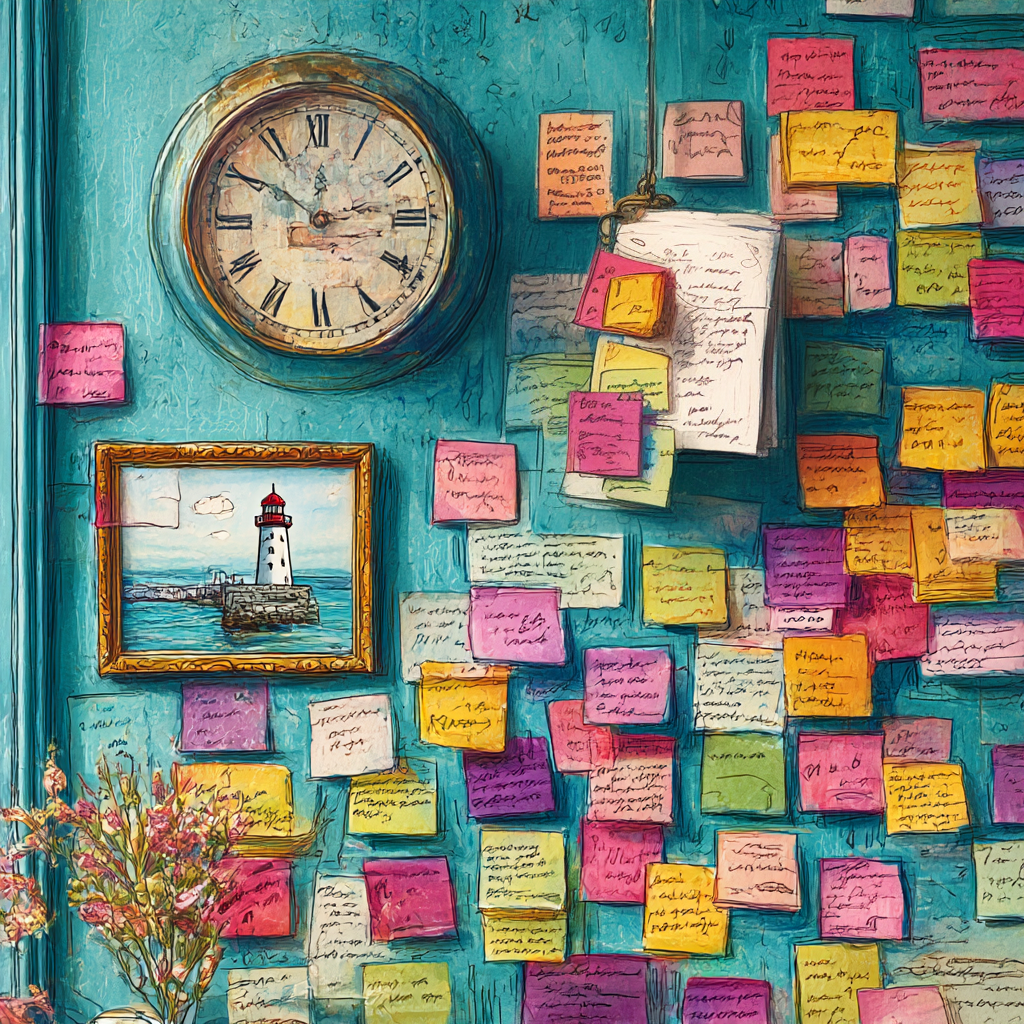
6. Keep a list, or keep Post-It pads around, and “catch” the thoughts you have. Sometimes the oddest combinations of tidbits find their way into a post together—but I would have lost them both if I didn’t write them down when they popped through my mind. (I don’t know about you, but the older I get, the better my “forgetter” works! I’m pretty sure there’s an inverse correlation: the more gray hairs I have, the fewer gray cells…) I always have a list on my phone, and I have sticky-note pads all over my house, and even in my car (in fact, I’m in the middle of writing a post about that). My son used to say, like putting a hashtag on a moment: “That sounds like a blog-title, Mom.” Now he’s grown and gone, and I have to catch those moments myself.
7. Don’t confine yourself to a restrictive subject or subject matter. Write about what YOU find to write about. When I started blogging, the “conventional wisdom” was that you should have a set topic for your blog, so you could build a following of people who wanted to know about that topic. I call baloney on that thinking! I was writing about my son’s ferret, and my daughter’s karate kick, and my husband’s singing, and what I was reading, and building a chicken house, and the frustrations of freelance writing, and how to make household cleaners from the things I could buy with my foodstamps, and… And and AND! And my following kept growing. Whatever you’re writing about, just be genuine.
8. Don’t be afraid to be open, and imperfect, and even vulnerable. People connect with you when you’re at your most HUMAN. That means not “tidying away” the messiness of real life, and not hiding the rough spots of your situation, or even your character. (I mean… Don’t share if it’s something on which you should plead the Fifth—but in that case you need a lawyer’s advice, not mine. Short of that, just be YOU.)
9. Post regularly. I didn’t write for several years after my husband died. Even after I’d remarried and life was liveable (and being lived) again, I didn’t return to the blog very often until a few months ago. My following dwindled from three thousand to fifteen hundred—because I wasn’t there! Now that I’ve been back, and posting several times a week, and engaging with other people’s blogs, and interacting with my commenters, my following and my site-traffic are slowly-but-steadily, correspondingly, increasing again.
10. Have fun! It shows. (And if you were slogging through it like a dreaded homework assignment, that would show too.) Besides, if we’re not enjoying this, what are we even doing here?
I hope all that is a help, Mr. Pickletoes! I’m honored that you asked it of me.

 Kana's Chronicles
Excellent comments on blogging. The interactions are key to the fun.
LikeLiked by 1 person
I’m in touch still with friends I made through blogging a decade ago… It has definitely enriched my life. :)
LikeLiked by 3 people
I’m relatively new to blogging, I’ve been doing it now for about a year and I started blogging in order to explain to my readers things that just needed more explanation in my books.
My “Advisor series” has a military aspect to it and there’s a lack of knowledge from many readers as to what the various acronyms mean when we deal with the military. Let me give you an example.
“His favorite weapon in Vietnam was the M79”
OK now unless you were a soldier in the Vietnam era you would have no idea what I was talking about. My son who was a Marine back in the early 2000s had no idea what that weapon was because the military had eliminated it from service. They changed it to an M203, and once again if you’re not familiar with the military what the heck am I talking about.
So when I started to blog part of my rationale was to give a further explanation of what I was talking about in my books, things that I took for granted, 50 years ago, are no longer even used in the US Army. So my blogs gave me an opportunity to expand upon and explain some of that nomenclature to my readers.
But as a military historian I had also written a number of books and articles dealing with military history, primarily the civil war. Again one of the things that you run into as a historian is you have fantastic stories that are written from a historical aspect that make outstanding short stories, historical fiction.
Over the years I had collected many of these stories from the research that I had done on my books or my articles, and I thought these would make wonderful stories of adventure, of survival, of chicanery, and just tell good stories.
So in my blogs occasionally I will include one of my civil war stories just for the reading enjoyment of those who are out there.
Another thing that I have done with my blogs is treated my readers with some of the other things that I do outside of writing. For example I am very active in our local civil war roundtable, a gathering of people that meet once a month and discuss various aspects of the civil war especially aspects of the civil war involving our local area. As a result of my military history training in the US Army usually once a year I give one of these talks or lead one of these talks about a topic of interest. So what I have done with my blogs is I have gone in and used the text from my presentations so that other historians or other people who are interested in civil war history can read and review and offer comments to what I’ve presented.
One of my locally inspired books,” The Most Hated Man in Clarksburg” has been well received in the community and I’ve been asked by our local museum to actually conduct bus tours of our town and visit locations in the town that are prominently discussed in the book. Now while the book itself is a historical fiction, the events, the locations, the personalities are all well documented of course. I have no idea what some of these men actually said, in some cases I have letters and writings, but in most cases who knows what the real verbiage was at the time period so that’s where the fiction comes into play trying to take that character and put him into historical perspective.
So during our tours we actually stop at locations that are prominent in the book and we will get out of the bus and we’ll stand there and visit the scene or in some cases enter the church or the house where these events actually took place. It gives me an opportunity to talk about the civil war in our hometown. Of course it also gives me an opportunity to hopefully sell some books as well.
And of course as an author trying to sell books I also make sure that at the end of my blog I direct my readers to my website where they can review and even sometimes purchase my books.
So I see that there are a wide variety of implications for what your blog can actually accomplish. It can be informative, it can answer additional questions, it can be provocative in raising issues that might not fit other places. It can be educational, or it can just be downright fun.
Whatever you do make your blog yours make it reflect your ideas, your adventures, and your own personality. Give your readers some insights into your works, why you write or discuss your topics of interest. Again being new to the blogging arena I really don’t feel I can give people any great gist’s of wisdom but that’s what I have done with mine and I hope that that My ideas might help someone else out there who is beginning or is looking for a way to expand their blog in a wide variety of ways.
Visit petetaylorauthor.com
Regards,
“Hardcharger”.
LikeLike
Oh, I’ve BEEN on your blog, and you have PLENTY of wisdom! ;)
What a treat, to actually get invited to host the historical bus tours. (I’m trying to think what the equivalent would be for my best-seller, but that’s an A.A. book, so I don’t see an easy tour association, lol…)
Some of my favorite series of books (Wheel of Time by Robert Jordan, Outlander by Diana Gabaldon) have “companion” books that dig deeper into those esoteric details of things that come up in the books—it sounds like your blog is the living “companion” piece to your own series. And what a great idea. Speaking as a reader, when I find a writer I love, I always want MORE! :)
LikeLike
Probably doesn’t hurt to have a weird mother.
LikeLike
Ha, it certainly goes in the “plus” column of MY life, oh Weird One! ;)
LikeLike
Thanks Kana for answering my question. You have put a lot of thought into your answers, I will dig deeper into them.
This is really my first interaction with Blogging, I have had several conversations on YouTube over the years.
I will let you know how my meet up goes.
Thanks again,
Roger
LikeLike
My pleasure—thank you for handing me that prompt to reflect about my practices. :)
LikeLike
Kana – what a generous and grounded reflection on the art of blogging. I especially appreciated your emphasis on reciprocity – the quiet exchange of curiosity and care that keeps this space alive. Your advice reads like a conversation between colleagues rather than a lecture, which makes it all the more encouraging. The reminder to write with openness and delight felt particularly relevant; joy tends to travel through the screen. Thank you for modelling sincerity as both craft and community practice.
LikeLiked by 1 person
It’s encouraging to think that I hit the right note and didn’t sound too school-marm-ish (especially as a former schoolmarm, lol). Thank you. Yours is precisely the type of comment I would encourage all of us to take as a model. :)
LikeLiked by 1 person
I really like numbers 1., 2., and 8 because you are keeping it real and emphasizing the fact that no matter how much someone might want to believe that their writing is so incredible that those who attempt to connect with them are just followers in awe of them ( a somewhat human trap which I think starry eyed new bloggers can easily fall into) the truth is that WP is a community of writers who began their blogs not to follow others but rather because they themselves want to be read.. . everyone here wants to be heard:)
I have come to think of this space as a huge writers workshop which requires investing of oneself in the work of others as well as receiving the wonderful support others have to offer as well.
LikeLike
A writers’ workshop is a great way to think of this space of ours! Certainly I continue to learn as I read… It’s easy for any of us to get hooked on chasing those site statistics or “likes”–so it’s always worthwhile remembering that, at its BEST, it’s not a one-sided conversation. :)
LikeLiked by 1 person
I lilke #6
LikeLike
That one is crucial for me! If I didn’t “catch” those thoughts when they flew through, I’d sit down at the computer and have no idea what to write about! ;)
LikeLike
You are right about the online friendships that form. I began my blog to promote my book. When COVID hit I started posting once a week. I usually snap a photo, or use old photos in my collection. A few folks started following, and I started reading their stuff. Learned a lot. I’ve slacked off writing for a while now, but I read other’s blogs every day.
Glad to find you, and look forward to reading more of your posts.
LikeLike
I’m thinking it was a sanity-saver, during COVID! It certainly was for me, further back, when I was working as a freelance writer and feeling isolated… When I needed a break from the dull-writing, I’d hop over to my world of FUN-writing friends. :)
LikeLike
Delightful advice….like a warm cup of tea for the soul☺️
LikeLike
I’m very glad you didn’t say “chicken soup,” lol ;)
LikeLiked by 1 person
Haha Ikr
LikeLike
Great advice! I have been waiting for such a blog! So you were right, there were other children in the class that did not dare to raise their hand. We have figured out some of it on our own, but your post really comes handy to reassure us. Thank you!
LikeLike
How gracious of you to come forward and say so! :)
LikeLike
Great advice here, thanks for posting and being so honest!
LikeLike
I’m tickled if it’s helpful!
LikeLiked by 1 person
Thanks for this!
LikeLike
You’re most welcome–I’m happy if it’s useful! :)
LikeLike
I’m glad you found my blog, looks like you started about a year before me. I mainly have conversations with other bloggers I know, so maybe this is a start in reaching out more broadly. ? Anyway, I liked your list.
LikeLike
Great answer and good advice. I tend to compose posts or have ideas for posts while I’m out hillwalking – that’s when I do all my deep thinking and solve lots of issues and so on…
LikeLike
Thanks for the blogging advice. I just started to blog a few months ago and several of this pointers will help. I never knew about the Alt Text all.
I do enjoy the picture part but i do find i get play with that part too much with the new AI tools. I actually wonder if I am distracting from what I am writing
LikeLike
That’s certainly worth being aware of. If I thought people would skip the reading because of my graphics, then I’d say that was too distracting. But I figure most people’s minds are good with reading AND graphics—and lots of people’s minds are drawn to the graphics to begin with, and go from there to the reading, so… I guess you could say I’m a fan of having pictures or graphics. (I confess it’s at least partly because I have FUN with them! :)
LikeLike